

Introduction
Three Black Crows and Three White Soldiers are among the most recognized multi-candle reversal patterns in Japanese candlestick trading.
Each consists of three consecutive candles and appears at significant market turning points. Traders rely on these patterns to signal a potential shift in trend, whether from bullish to bearish or vice versa.
In this guide, you’ll learn how to identify, interpret, and trade these patterns — and when to avoid them. We’ll also look at confirmation tools to improve accuracy, such as momentum indicators, support/resistance levels, and overall market structure.
Summary: Pattern Quick Reference Table
This table offers a side-by-side view of the core elements of both patterns and how to confirm them.
| Pattern | Market Direction | Candle Features | Confirmation Tools |
| Three White Soldiers | Bullish Reversal | 3 long bullish candles after a downtrend | TSI rising, support level bounce |
| Three Black Crows | Bearish Reversal | 3 long bearish candles after an uptrend | TSI falling, resistance rejection |
Table of Contents
- Introduction
- Summary: Pattern Quick Reference Table
- What Are the Three White Soldiers?
- What Are the Three Black Crows?
- Why These Patterns Matter
- When to Trade These Patterns
- Three White Soldiers Example: USD/CHF Reversal
- Three Black Crows Example: AUD/CAD Top
- When These Patterns Fail
- Confirmation Tools to Improve Accuracy
- Tips for Trading These Patterns
- Common Mistakes to Avoid
- Should You Use Filters?
- What Are Your Next Steps?
- Frequently Asked Questions
- Forex Trading Disclosure Statement
What Are the Three White Soldiers?
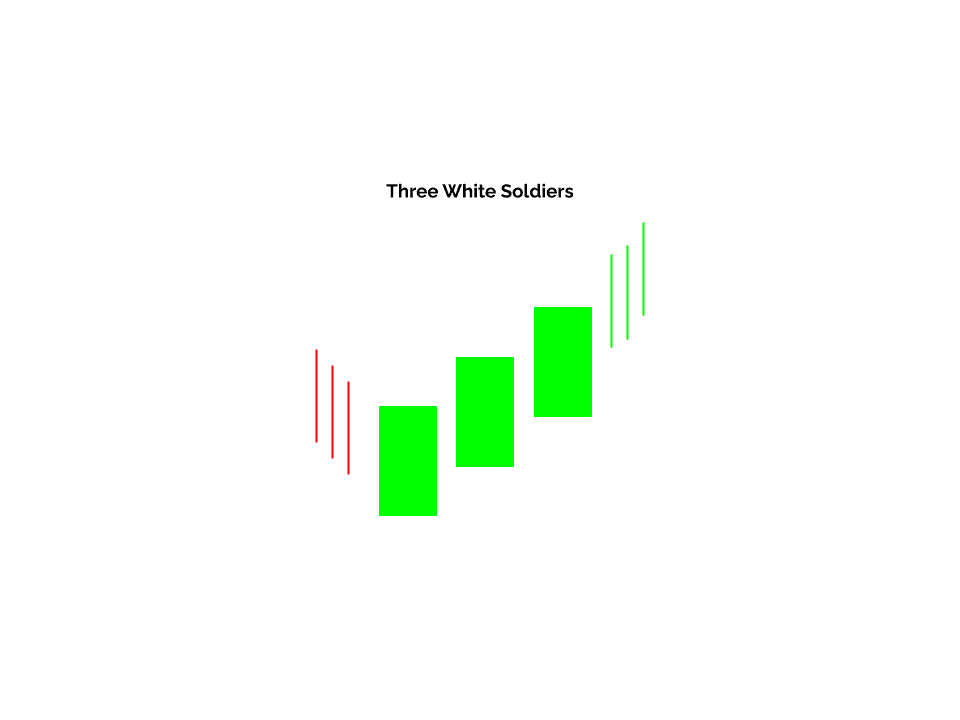
The Three White Soldiers is a bullish reversal pattern that occurs after a downtrend or significant pullback. It signals strong buying interest and often indicates the beginning of a new uptrend.
Structure:
- Three consecutive bullish candles
- Each opens within or near the previous candle’s real body
- Each candle closes near its high, showing strength
The ideal version of this pattern features little to no wicks, which shows confident upward movement.
What Are the Three Black Crows?
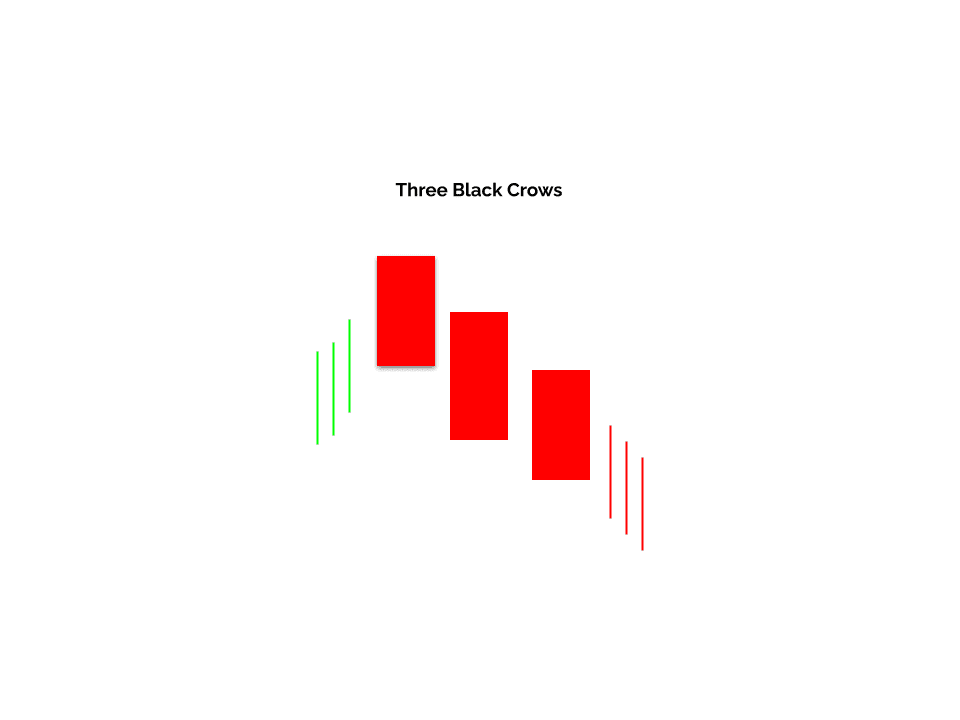
The Three Black Crows is a bearish reversal pattern found after an uptrend or rally. It reflects sustained selling pressure and may mark the start of a downward trend.
Structure:
- Three consecutive bearish candles
- Each opens within or near the previous candle’s real body
- Each candle closes near its low, indicating weakness
Like its bullish counterpart, the pattern is strongest when the candles are large and without long lower wicks.
Why These Patterns Matter
These patterns are significant because they show control shifting between buyers and sellers over multiple sessions — a key characteristic of genuine reversals. They also allow traders to:
- Time trend reversals
- Confirm exits or entries
- Spot institutional accumulation or distribution
However, not all patterns lead to successful trades. Context and confirmation are essential.
When to Trade These Patterns
The Three White Soldiers and Three Black Crows work best when:
- They occur at key support/resistance levels
- Price has been overextended in the prior trend
- A momentum indicator like the TSI agrees with the new direction
Let’s break down both setups in real chart scenarios.
Three White Soldiers Example: USD/CHF Reversal
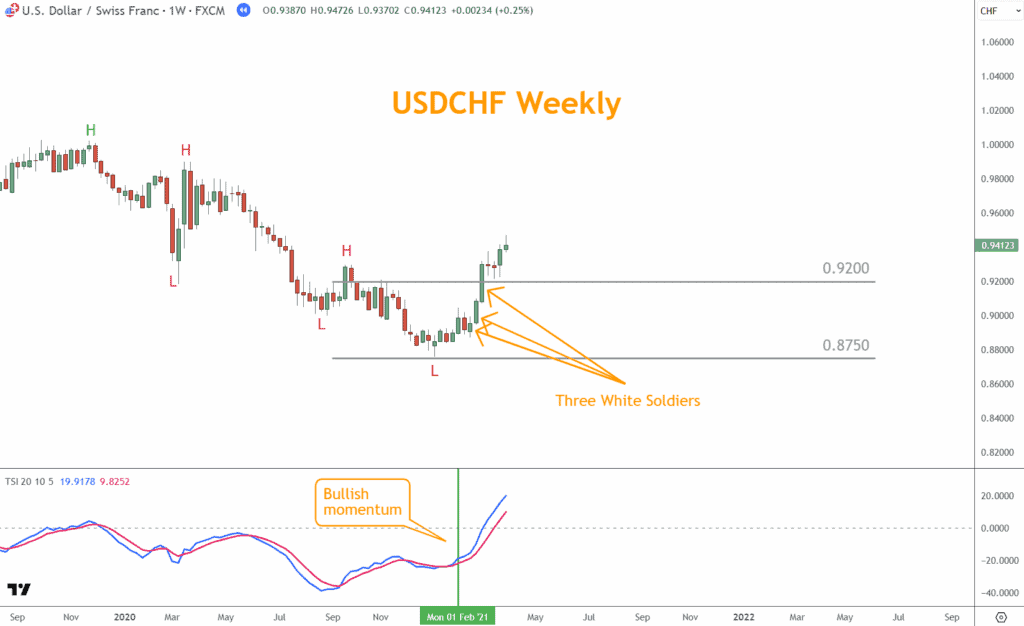
Date: March 2021
Context: A downtrend had just bottomed near a long-term horizontal support line.
- Prices forming a bottom around 0.8750
- Three consecutive bullish candles finished with a close above 0.9200
- The last two have minimal shadows, implying more bullish psychology
- TSI turned bullish
Outcome: USD/CHF rallied 123+ pips over the next four weeks.
This setup combined price structure (support), momentum (TSI), and candlestick confirmation — a textbook reversal.

Looking for a Strategy?
Download the Six Basics of Chart Analysis and sign up for Forex Forecast to learn a bottom-up approach to analyzing Forex markets and weekly market updates.
Three Black Crows Example: AUD/CAD Top
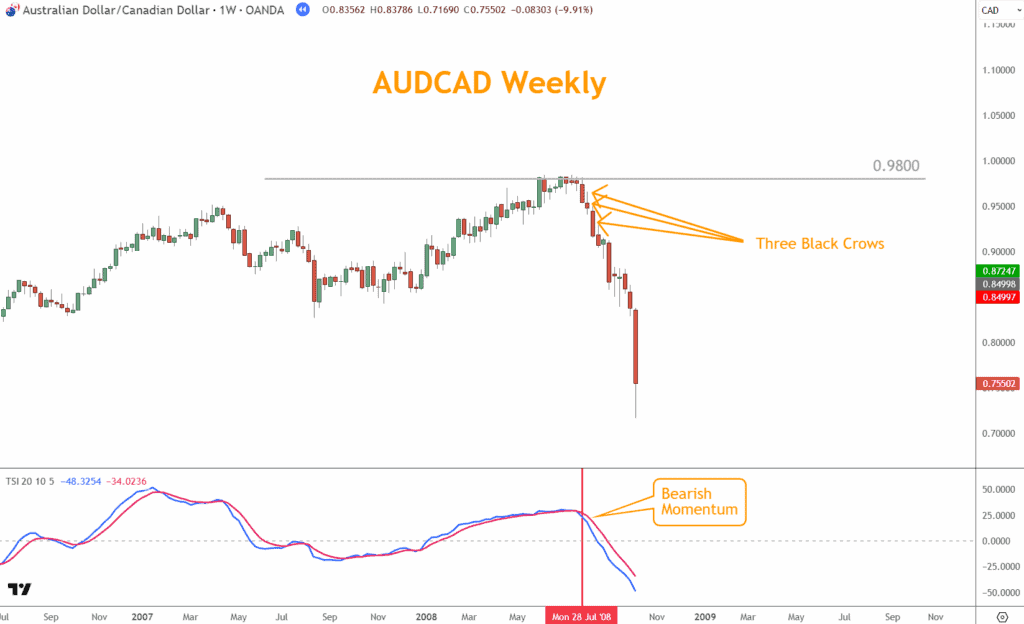
Date: July 2008
Context: AUD/CAD was making new highs, but momentum stalled
- Prices consolidated near 0.9800 with a series of Spinning Tops
- The second candle in the pattern is a less than ideal Doji, but the 3rd candle is a Bearish Marubozu with conviction.
- TSI moved quickly to a Bearish state
Outcome: The pair fell over 2200 pips in the next eight weeks.
Here, the pattern found resistance at 0.9800 that AUD/CAD couldn’t overcome.
When These Patterns Fail
Neither pattern is reliable in sideways or consolidating markets. Here’s when they tend to break down:
- Three White Soldiers Failures: In range-bound markets, bullish candles may signal only a temporary push, not a reversal.
- Three Black Crows Failures: Without confirmation, they may appear during pullbacks in a larger bullish trend, leading to false signals.
Always ask: Is this a reversal… or just a correction?
Confirmation Tools to Improve Accuracy
Using confirmation tools with candlestick patterns can improve your win rate. Here’s what to combine:
- Support and Resistance
- Look for patterns forming near horizontal support (soldiers) or resistance (crows)
- In the AUD/CAD example below, look at the consolidation occurring at 0.9800 before the pattern appeared and prices fell.
- Look for patterns forming near horizontal support (soldiers) or resistance (crows)
- Momentum Indicators
- TSI: Use to confirm overbought/oversold or divergence
- In the example below, look how the TSI momentum turned bullish before the candle patterns’ appearance.
- The Three White Soldiers serve as confirmation of the reversal.
- The Three White Soldiers serve as confirmation of the reversal.
- In the example below, look how the TSI momentum turned bullish before the candle patterns’ appearance.
- TSI: Use to confirm overbought/oversold or divergence
Tips for Trading These Patterns
Here are some practical ways to use these patterns in your strategy:
- Entry: After the third candle closes (not before)
- Stop Loss: Below the pattern (for soldiers), above it (for crows)
- Target: Use recent swing highs/lows, or support/resistance levels
- Avoid: Trading them inside consolidation zones
These patterns are not entry signals on their own. They are context signals — use them to validate a setup.
Common Mistakes to Avoid
- Trading without confirmation
Don’t rely solely on the pattern — look for supporting evidence. - Ignoring trend context
A bullish reversal pattern in an uptrend is often just a continuation, not a reversal. - Forcing the pattern
The candles must be clearly formed. Don’t stretch the rules to “make it fit.”
Should You Use Filters?
Yes — adding a filter, such as TSI or support/resistance validation, dramatically improves the quality of these signals.
The tradeoff is fewer setups, but the accuracy and confidence go up.
What Are Your Next Steps?
If you’re interested in using Three White Soldiers and Three Black Crows in your Forex trading:
- Review your charts on the weekly timeframe
- Mark support and resistance zones
- Use TSI to confirm reversals
- Try to identify Three White Soldiers and Three Black Crows patterns.
Want to trade with more clarity?
Download the free Six Basics of Chart Analysis and subscribe to the weekly Forex Forecast newsletter to get setups like these delivered every Sunday.

Frequently Asked Questions
Are Three White Soldiers and Three Black Crows reliable?
They can be — when used with confirmation. Alone, they have a moderate success rate, but when combined with market structure and momentum, they offer high-quality reversal signals.
How do I confirm these patterns?
Use tools like:
- Support/resistance zones
- Momentum indicators (TSI)
- Price structure (swing highs/lows)
Should I trade the pattern before the third candle closes?
No. Wait for the third candle to close fully. Premature entries often lead to false breakouts or failed setups.
Forex Trading Disclosure Statement
Risk Warning:
Forex trading involves significant risk and may not be suitable for all investors. The leveraged nature of Forex trading can work both for and against you, leading to substantial gains or losses. Before trading Forex, you should carefully consider your financial objectives, experience level, and risk tolerance. It is possible to lose more than your initial investment, and you should only trade with money you can afford to lose.
Market Risks and Volatility:
Forex markets are influenced by global economic, political, and social events, which can result in unpredictable price movements. High market volatility can lead to sudden and substantial changes in currency values, potentially causing losses that exceed your initial deposit.
Leverage Risks:
Leverage amplifies both potential gains and potential losses. While leverage can increase profitability, it also increases the risk of significant losses, including the loss of your entire trading capital.
Trading Tools and Technology Risks:
Forex trading platforms, including those offered by brokers, are subject to technology risks, such as system failures, latency issues, and potential errors in price feeds. Traders should be aware that these risks can impact the execution of trades and trading outcomes.
No Guarantee of Profitability:
Past performance in Forex trading is not indicative of future results. There is no guarantee that you will achieve profits or avoid losses when trading Forex. Market conditions and individual trading strategies vary, and no trading system can eliminate the inherent risks of Forex trading.
Educational Purposes Only:
Any information provided about Forex trading, including strategies, analysis, or market commentary, is for educational purposes only and should not be considered financial advice. Consult a qualified financial advisor or tax professional before making any trading decisions.
Regulatory Compliance:
Forex trading is regulated differently in various jurisdictions. Ensure that you are trading with a licensed and compliant broker in your country of residence.
Responsibility:
You are solely responsible for your trading decisions and the associated risks. You must understand the terms and conditions of Forex trading, including margin requirements, stop-losses, and other risk management tools.
Acknowledgment:
By engaging in Forex trading, you acknowledge that you have read, understood, and accepted this disclosure statement. You assume full responsibility for the outcomes of your trading decisions and agree to trade at your own risk.