
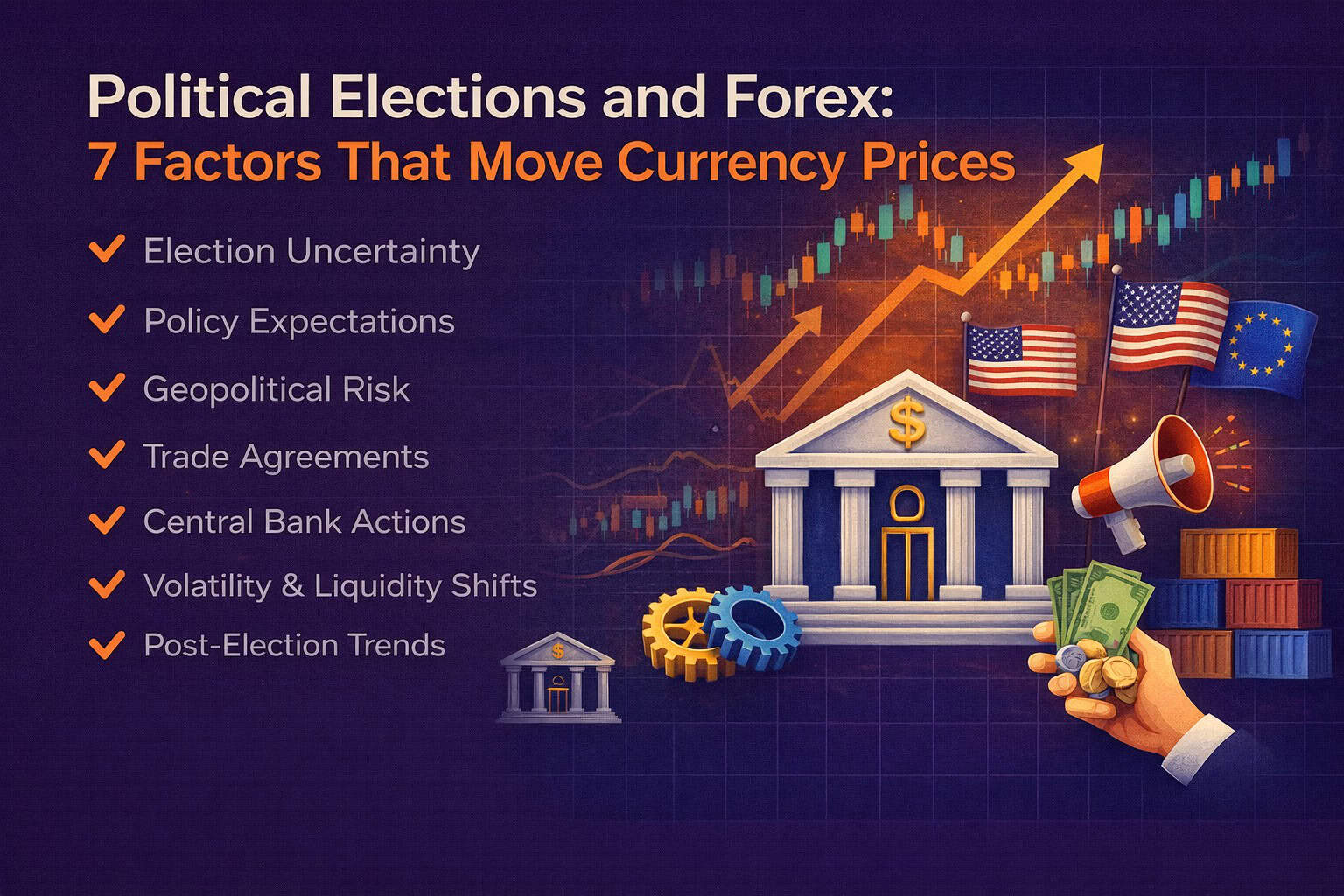
Political elections and Forex price movement are closely linked—often well before ballots are cast and long after results are finalized.
Elections introduce uncertainty, policy risk, and shifting expectations, all of which directly influence currency prices.
For Forex traders, elections are not just political events—they are macro catalysts that can trigger volatility, trend changes, and long-term repricing.
This article explains how and why elections move currencies, what matters before, during, and after voting, and how traders can manage risk without guessing outcomes.
TL;DR
- Elections inject uncertainty, which drives volatility in Forex markets
- Markets react to policy expectations, not just election results
- Pre-election periods favor caution; post-election periods favor trend clarity
- Central banks often delay action until political direction is known
- Position traders benefit most by waiting for policy execution, not headlines
Why Politics Influences Forex Prices
Currencies represent economic confidence. Elections challenge that confidence by introducing uncertainty about future leadership, policy direction, and global relationships.
Key Political Drivers of Currency Movement
| Factor | Why It Matters | Typical Market Reaction |
| Market uncertainty | Unknown leadership and policies | Higher volatility |
| Economic policy expectations | Fiscal and regulatory shifts | Pre-election repricing |
| Trade policy changes | Tariffs and agreements affect capital flows | Currency strength or weakness |
| Investor sentiment | Risk-on vs. risk-off behavior | Safe-haven flows |
Markets price expectations first, outcomes second.
How Economic Policy Expectations Move Markets
Political campaigns are forward-looking narratives. Traders assess whether proposed policies imply:
- Higher inflation
- Increased debt issuance
- Faster or slower economic growth
- Pressure on central banks
A government favoring aggressive spending may weaken a currency.
A fiscally conservative platform may strengthen it—before the vote even occurs.

Looking for a Strategy?
Download the Six Basics of Chart Analysis and sign up for Forex Forecast to learn a bottom-up approach to analyzing Forex markets and weekly market updates.
Trade Relations and Global Spillover Effects
Elections can reshape trade relationships overnight.
Policy shifts toward protectionism or trade expansion affect:
- Export competitiveness
- Capital flows
- Partner currencies
Because the Forex market is relative, one country’s election can affect several currencies simultaneously.
Elections and Forex: A Timeline Perspective
Understanding when markets react is just as important as understanding why.
Market Behavior Across Election Phases
| Phase | Market Focus | Primary Risk | Best Trader Response |
| Pre-election | Polls, rhetoric, promises | Whipsaws, thin liquidity | Reduce size, stay selective |
| Election day | Results and surprises | Extreme volatility | Avoid prediction-based trades |
| Post-election | Policy execution | False breakouts | Wait for confirmation |
Pre-Election Period: What Traders Should Watch
Campaign Promises and Policy Signals
Markets listen closely to:
- Tax policy proposals
- Spending plans
- Regulatory shifts
These signals often drive anticipatory positioning rather than outcomes.
Polls and Sentiment Shifts
Poll momentum matters more than absolute numbers.
Sudden shifts can cause sharp repricing—especially in tightly contested elections.
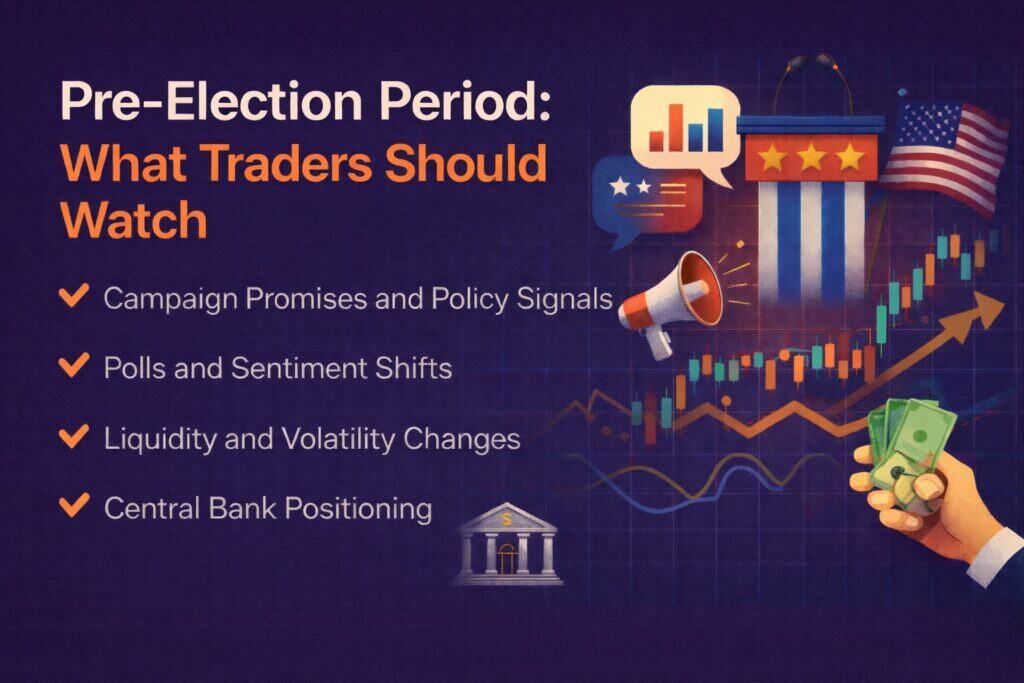
Liquidity and Volatility Changes
As elections approach:
- Liquidity often declines
- Spreads widen
- Price moves become erratic
This is not an environment for aggressive sizing.
Central Bank Positioning
Central banks often pause policy decisions until political clarity emerges.
Traders should watch language changes, not actions, during this period.
Election Day: Real-Time Market Dynamics
Election day trading is driven by emotion, speed, and uncertainty.
What Typically Happens
- Sharp, fast price swings
- Overreaction to partial results
- Liquidity gaps
Risk Management Is Non-Negotiable
Traders should consider:
- Smaller position sizes
- Wider stops—or no trades at all
- Hedging existing exposure
Prediction is not a strategy.
Post-Election: Where Trends Form
Markets calm down once outcomes are known—but trends form only when policy execution begins.
Policy Follow-Through Matters
Currencies respond to:
- Speed of reform implementation
- Legislative feasibility
- Credibility of leadership
Markets reward clarity, not promises.
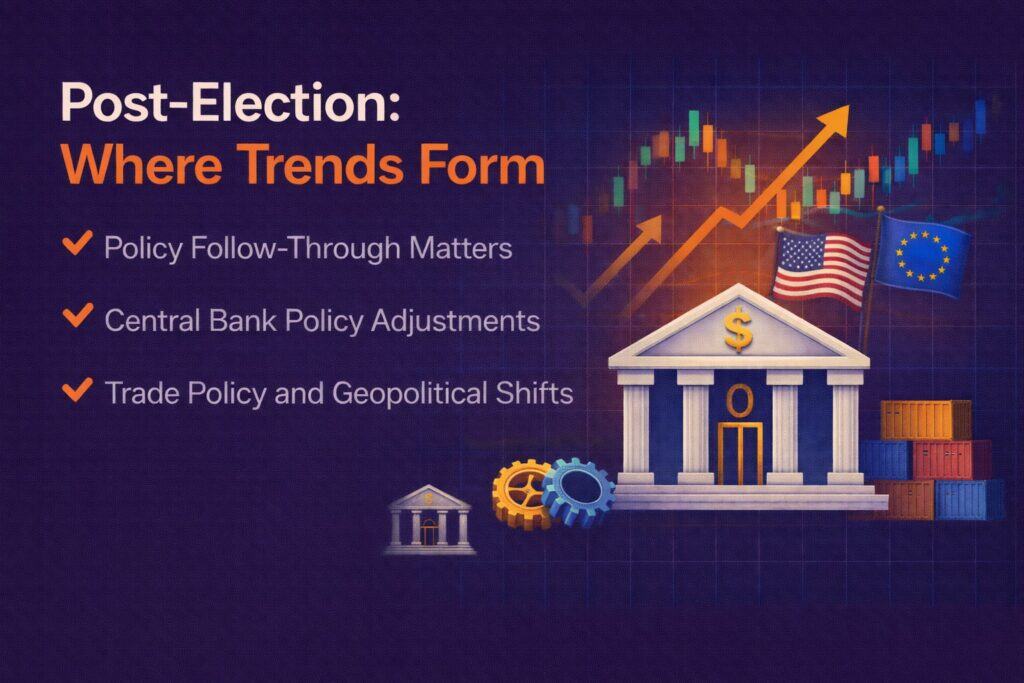
Central Bank Policy Adjustments
New governments influence:
- Inflation expectations
- Interest rate paths
- Monetary coordination
Central banks often react after political direction becomes clear.
Trade Policy and Geopolitical Shifts
Changes in alliances, tariffs, or sanctions can reshape currency valuations—especially in trade-dependent economies.
Historical Case Studies
| Event | Currency Impact | Key Lesson |
| Brexit (2016) | GBP collapse | Markets punish uncertainty |
| US Election (2020) | USD volatility | Fiscal expectations dominate |
| Emerging market elections | Capital flight | Political risk premiums rise |
Election-Based Forex Trading Approaches
| Strategy Type | Best Environment | Primary Risk | Best Practice |
| Short-term trading | Election day volatility | Slippage | Reduce size |
| Position trading | Post-election clarity | Patience | Wait for structure |
| Hedging | Pre-election uncertainty | Cost | Protect downside |
Position trading aligns best with policy-driven trends, not election noise.
Conclusion
Political elections are powerful macro events that shape Forex markets through uncertainty, expectations, and policy transitions.
Traders who attempt to predict winners often fail. Traders who understand how markets price political risk gain an edge.
The most consistent opportunities emerge after elections, once policy direction becomes actionable and volatility subsides.
What’s the Next Step?
Evaluate how political risk fits into your trading process:
- Are you reacting to headlines or waiting for confirmation?
- Do elections change your risk exposure?
- Are you trading noise—or positioning for policy-driven trends?
If you want a position-trading framework that works across political cycles, learn The Six Basics of Chart Analysis and Forex Forecast.

This approach keeps your focus on price, structure, and macro context, helping you trade trends that persist long after election headlines fade.
Quiz: Political Elections and Forex
Questions
- Why do elections increase Forex volatility?
A. Higher trading volume
B. Reduced spreads
C. Policy uncertainty
D. Central bank holidays - When do Forex markets typically reprice most aggressively?
A. After policy execution
B. During campaign debates
C. On election day only
D. When expectations shift - Which traders benefit most from post-election clarity?
A. Scalpers
B. Arbitrage traders
C. Position traders
D. News traders - Why do central banks often delay policy moves during elections?
A. Legal restrictions
B. Political pressure
C. Lack of liquidity
D. Outcome uncertainty - What is the primary risk of trading on election day?
A. Low volume
B. Predictable trends
C. Reduced volatility
D. Sudden price gaps
Answer Key
- C
- D
- C
- D
- D
Forex Trading Disclosure Statement
Risk Warning: Forex trading involves significant risk and may not be suitable for all investors. The leveraged nature of Forex trading can work both for and against you, leading to substantial gains or losses. You should carefully consider your financial objectives, experience, and risk tolerance.
Market Risks and Volatility: Forex markets are influenced by global events that can cause unpredictable movements. High volatility can lead to losses beyond your initial deposit.
Leverage Risks: While leverage can magnify profits, it also increases the risk of large losses. You may lose your entire capital.
Trading Tools and Technology Risks: Platforms are subject to failures, latency, and errors, which may affect trade execution.
No Guarantee of Profitability: Past results do not indicate future performance. No system can eliminate trading risks.
Educational Purposes Only: Information provided here is for education, not financial advice. Consult a financial advisor before making decisions.
Regulatory Compliance: Ensure you trade with a licensed broker in your jurisdiction.
Responsibility: You are solely responsible for your trading choices and risks.
Acknowledgment: By trading Forex, you accept these risks and trade at your own risk.